|
|
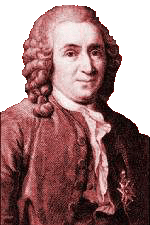
Carl von Linné (Carolus Linnaeus) |
|
Linné is the founder of modern biological systematics and the uniformly binary nomenclature,
according to which every organism has one genus- and one species-name. In his "Systema
naturae" of 1735, he developed a systematical classification of all plants within botanic. In later
editions of this work he refined on the system and extended it on animals. These classifications are,
in modified forms, still valid today. Since the times of the antiquity scientists had been using the
sytematics developed by Aristotle. But expeditions in the 16th and 17th century had discovered a sheer
endless increasing number of new species. Therefore, a very nonuniform system of naming was used in
botany, often ending up in very long names. The new thing in Linné's system was his idea of
hierarchically structuring the organisms according to similarities into regnum, classis, ordo, genus,
species and varietas (= subspecies). The distinction between Linné on the one and Aristotle and
others on the other side was that he did not divide the species by their habitats but according to
morphological features. The base of his classifications in botany were the genitalia and the stamens
and carpels of the plants. (A. Pashos, Translation: B. Gedrose & A. Pashos) |