|
|
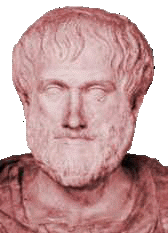
Aristotle (Aristotéles) Aristotle was born in 384 BC in Stagira, a place on Chalkidike (since King Philip part of Macedonia). At the age of 17 he went to Athens to study at Plato's Academy. First being a student and becoming a teacher himself later on, he stayed there for 20 years until Plato's death. Afterwards he followed an invitation of the ruler of Assos, Hermia. In Assos (Asia Minor) he married Hermia's niece, Phytias. After Hermia's murdering he went to Mytilene on Lesbos. Between 343/2 and 340, Aristotle became teacher of the young Alexander the Great at court of King Philip in Pella, capitol of Macedonia. In 335 he returned to Athens and founded there his own school, the Lykeion (Lyceum). After Pythias' death, he lived with Herpyllis. They had a son, Nikomachos. During the anti-Macedonian agitation after Alexander's death, Aristotle fled to Chalcis on Euboea in 323, where he died the following year (322 BC). |
|
Aristotle's philosophy mainly differed from that of his former teacher Plato in the rejection of his
Theory of Ideas. Aristotle is considered to be the founder of scientific logic. Up to the 20th century,
one only meant the Aristotelean Logic when speaking of logic. In and around his philosophical
works, he also investigated various research fields. Within his work as teacher, he made numerous
scripts on themes of natural science, metaphysics, ethics, poetry and rhetoric. |
|
(A. Pashos, Translation: B. Gedrose & A. Pashos) |