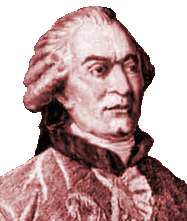
Georges-Louis Leclerc Comte de  Buffon

De Buffon was born in 1707 in Montbard, Bourgogne (Burgundy), as bourgeois Georges-Louis Leclerc. Due to a big heritage his mother made, his father was able to become a notable citizen of Dijon in 1714 and he acquired the village of Buffon in 1717. Since 1725, Georges-Louis was holding the name Leclerc de Buffon. De Buffon was educated as a jurist and physician, but he was most interested in natural history. Being a young man, he travelled to Italy and England (1730/32). Due to the considerably capital of his family, he was financially independent and therefore able to dedicate himself from his 25th year of life on wholly to the natural sciences. The wealthy landholder and industrialist de Buffon is also known as a mathematician (probability theory). In 1739 he became the intendant of the royal gardens, the ‚Jardin du Roi' and ‚Musée de Roi (afterwards 'Jardin des Plantes') which later on should become the ‚Muséum national d'histoire naturelle' in Paris. Under his direction the park developed to a scientific institution. From 1749 on, de Buffon began publishing the 36 volumes of his encyclopaedia "Histoire naturelle". (It later had 44 volumes and was published in the years 1749 to 1804). In 1753, de Buffon was appointed to the Académie française. In 1773, Louis XV created him Comte (count) de Buffon. He died 1788 in Paris.


Versatile scientist de Buffon wasn't of the opinion that all species in nature are unchangeably. He thought that the majority of variations were created by the environment. This thought was carried on by one of his scholars, Jean-Baptiste Lamarck (1744-1829). De Buffon classed humans and apes to one natural family, as well as he did with donkey and horse. But beyond everything else, as a consequence of his experiments, he estimated the earth's age much higher than the 6000 years presumed by the church. (He made experiments in his iron and steel works with cooling iron balls).
By his appointment to the Académie française in 1953 he declaimed, instead of the customary eulogy on his predecessor, the famous "Discours sur le style". From this declamation is taken the phrase: "Le style, c'est de l'homme même". His "Histoire naturelle", is above all known in France as a literary masterpiece. Besides for his literary works, de Buffon became popular throughout Europe for his physical experiments. However, he thought not much of Carl Linné (1707-1778) and his systematics.

(A. Pashos, Translation: B. Gedrose & A. Pashos)